Event report at “Global Cement” Magazine
“Report cemfuels Asia“
Issue 3/2026
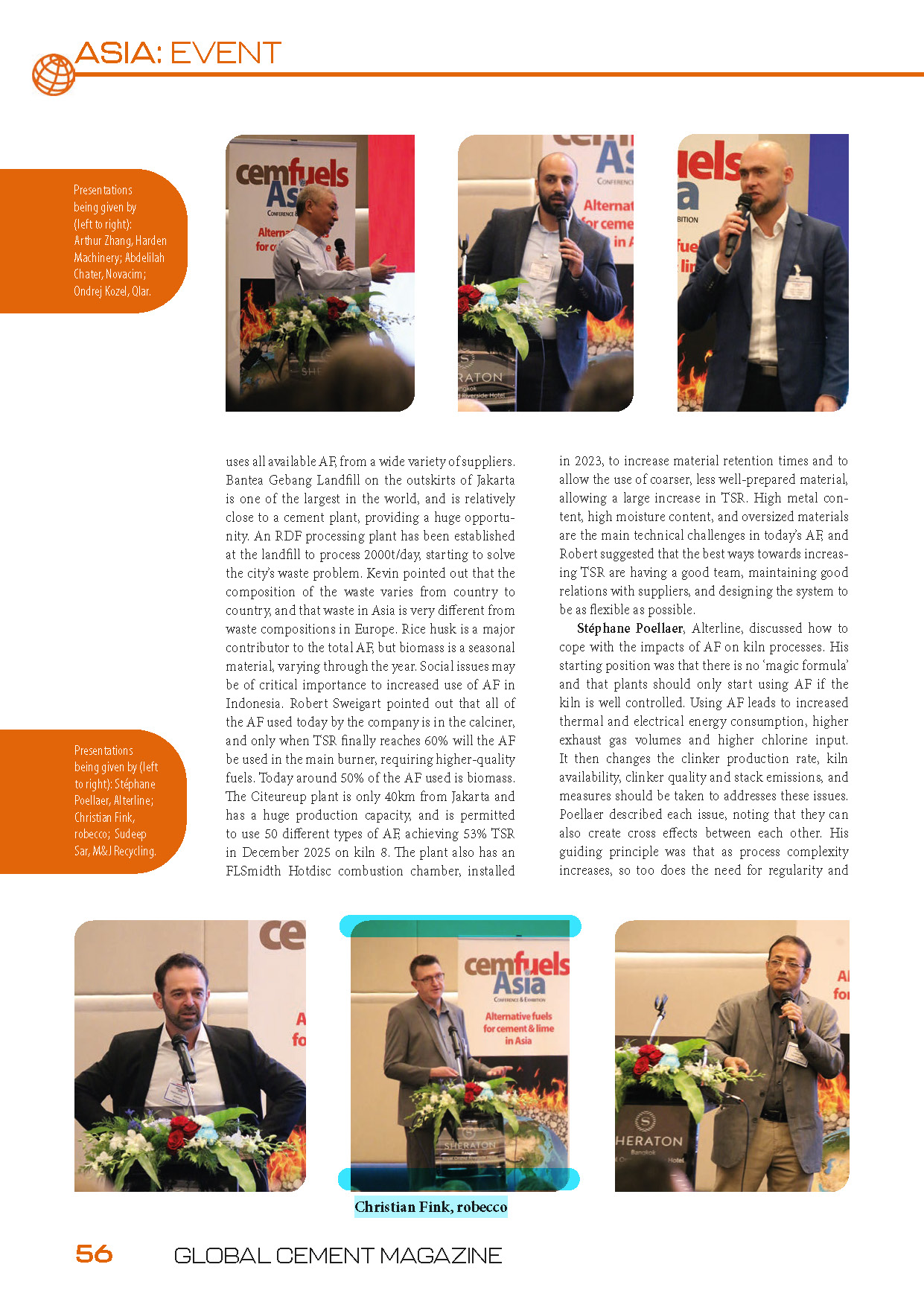
a.o. Lecture of Christian Fink, robecco
publication GLOBAL CEMENT / Report: Cemfuels Asia, robecco 03. 2026E-paper (robecco S.54):
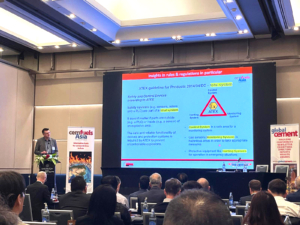
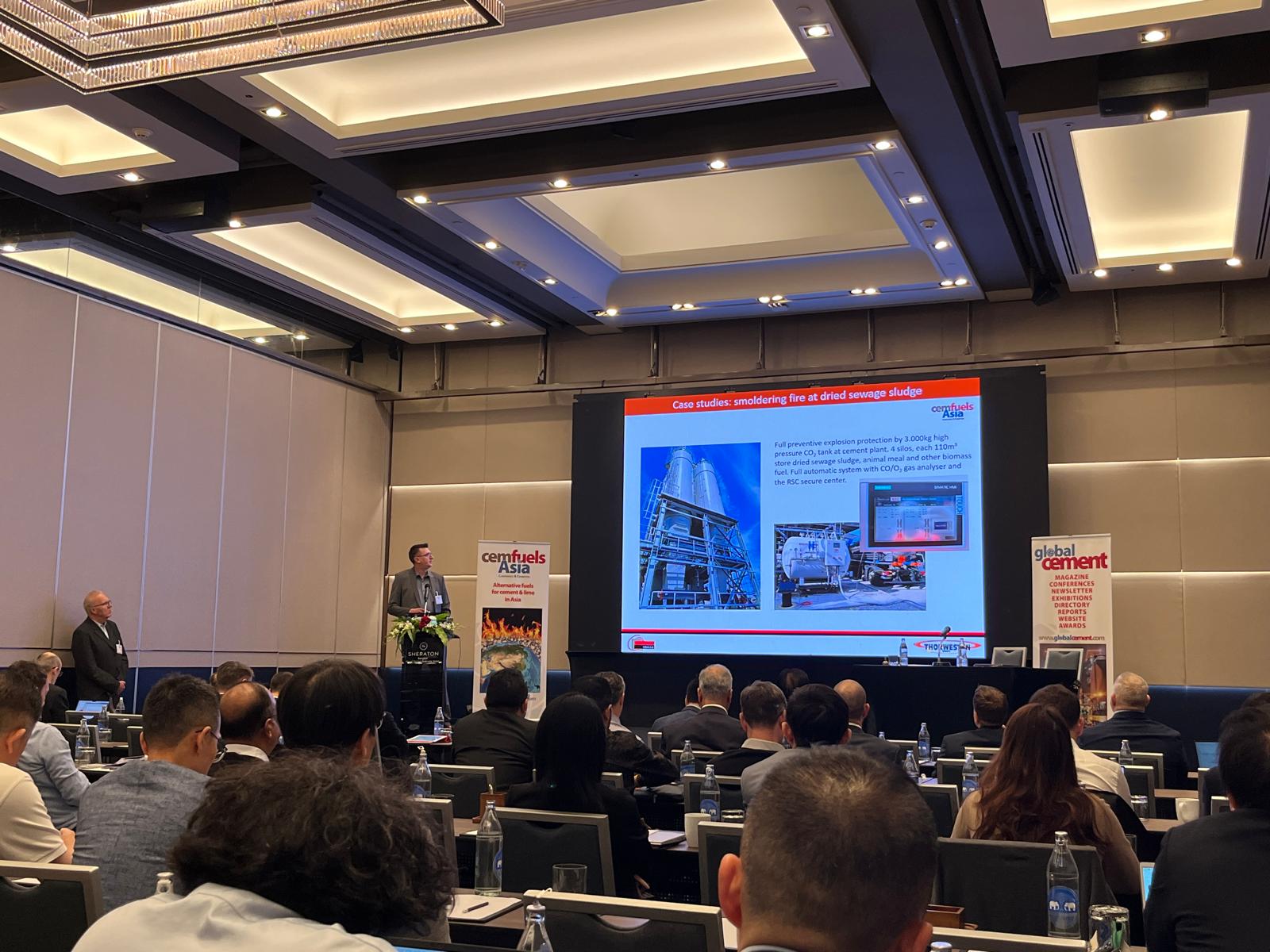
INERTING as an effective method to prevent explosions
Alternative Fuels: Insights in safe handling and storage.
REPORT:
CEMFUELS ASIA
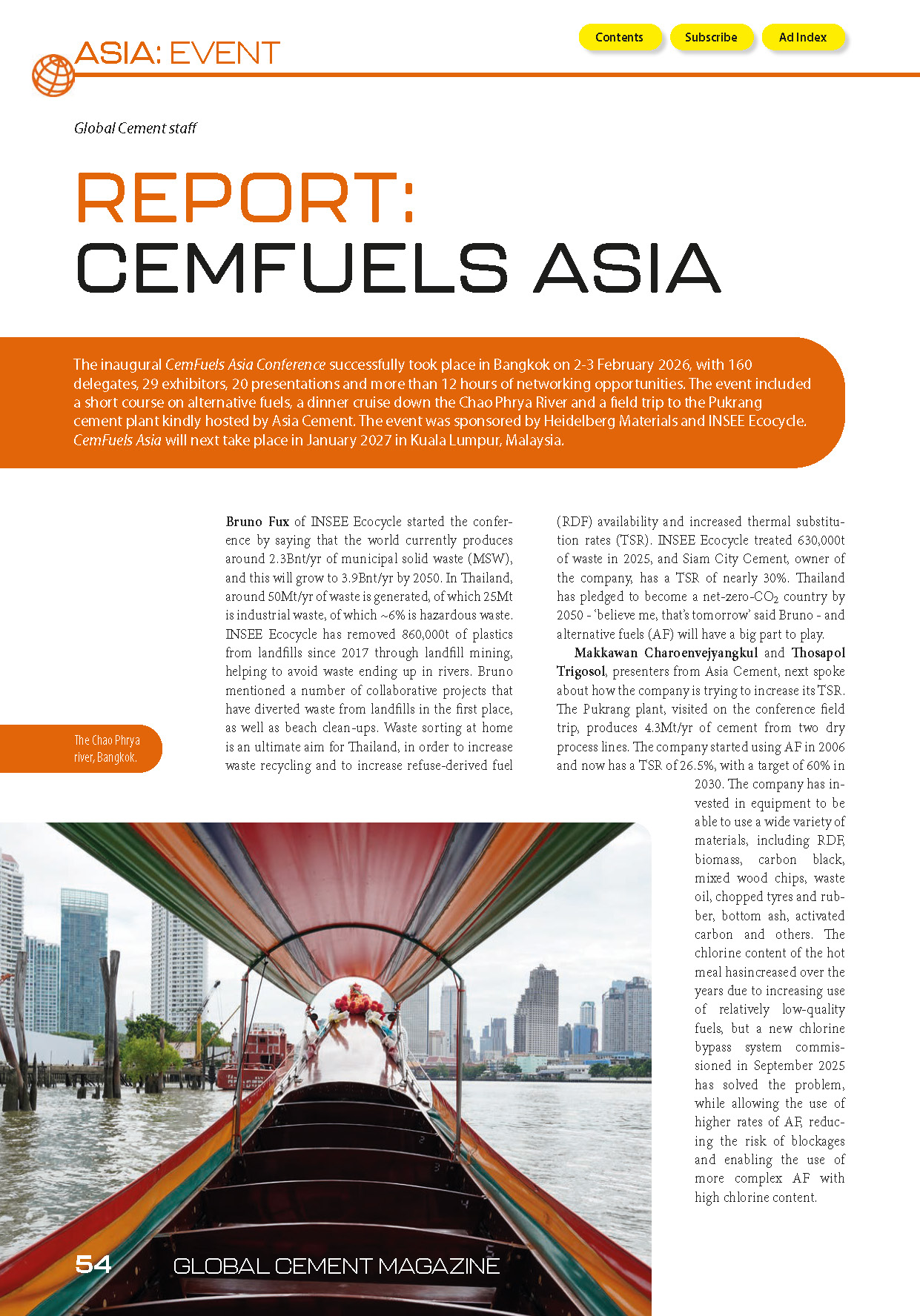
The inaugural CemFuels Asia Conference successfully took place in Bangkok on 2-3 February 2026, with 160 delegates, 29 exhibitors, 20 presentations and more than 12 hours of networking opportunities. The event included a short course on alternative fuels, a dinner cruise down the Chao Phrya River and a fi eld trip to the Pukrang cement plant kindly hosted by Asia Cement. The event was sponsored by Heidelberg Materials and INSEE Ecocycle. CemFuels Asia will next take place in January 2027 in Kuala Lumpur, Malaysia.
Bruno Fux of INSEE Ecocycle started the confer-ence by saying that the world currently produces around 2.3Bnt/yr of municipal solid waste (MSW), and this will grow to 3.9Bnt/yr by 2050. In Th ailand, around 50Mt/yr of waste is generated, of which 25Mt is industrial waste, of which ~6% is hazardous waste. INSEE Ecocycle has removed 860,000t of plastics from landfi lls since 2017 through landfi ll mining, helping to avoid waste ending up in rivers. Bruno mentioned a number of collaborative projects that have diverted waste from landfi lls in the fi rst place, as well as beach clean-ups. Waste sorting at home is an ultimate aim for Th ailand, in order to increase waste recycling and to increase refuse-derived fuel (RDF) availability and increased thermal substitu-tion rates (TSR). INSEE Ecocycle treated 630,000t of waste in 2025, and Siam City Cement, owner of the company, has a TSR of nearly 30%. Th ailand has pledged to become a net-zero-CO2 country by 2050 – ‘believe me, that’s tomorrow’ said Bruno – and alternative fuels (AF) will have a big part to play.
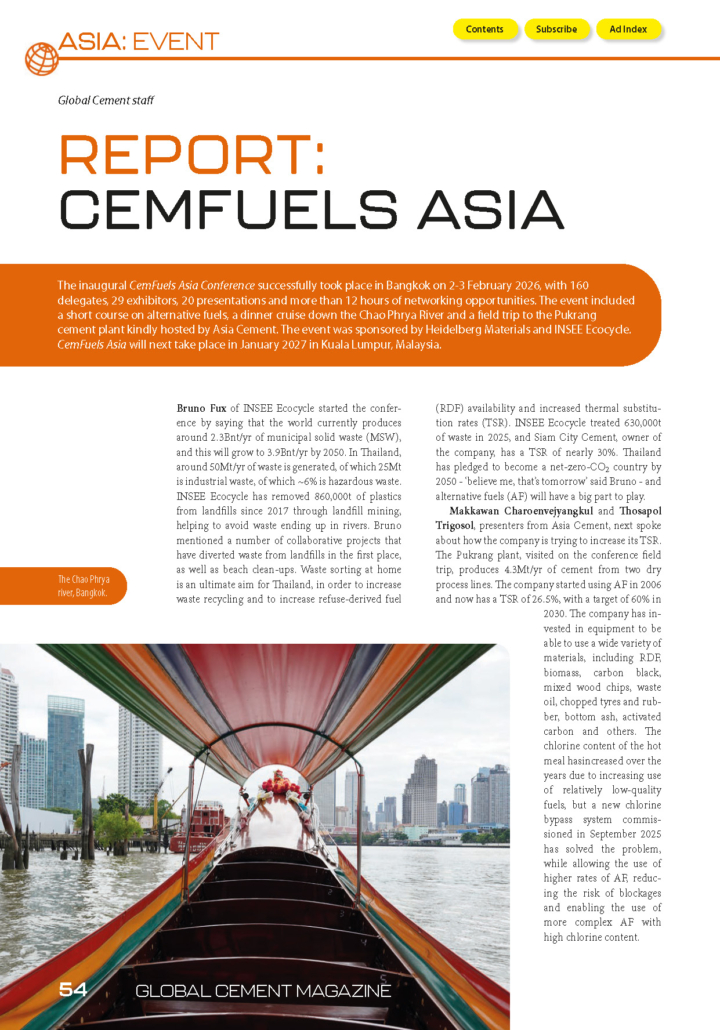
Makkawan Charoenvejyangkul and Th osapol Trigosol, presenters from Asia Cement, next spoke about how the company is trying to increase its TSR. Th e Pukrang plant, visited on the conference fi eld trip, produces 4.3Mt/yr of cement from two dry process lines. Th e company started using AF in 2006 and now has a TSR of 26.5%, with a target of 60% in 2030. Th e company has in-vested in equipment to be able to use a wide variety of materials, including RDF, biomass, carbon black, mixed wood chips, waste oil, chopped tyres and rub-ber, bottom ash, activated carbon and others. Th e chlorine content of the hot meal hasincreased over the years due to increasing use of relatively low-quality fuels, but a new chlorine bypass system commis-sioned in September 2025 has solved the problem, while allowing the use of higher rates of AF, reduc-ing the risk of blockages and enabling the use of more complex AF with high chlorine content.
Peter Yang from Xi’an Zaize Energy-saving Technol-ogy Co., spoke about China’s use of AF. Chinese cement production capacity has reduced from a high of 2.5Bnt in 2014 to 1.9Bnt in 2025, while production in 2025 was around 900Mt, implying a capacity utilisation rate of 47%. Although the Chinese cement industry is charac-terised by advanced technology and modern equipment, there is serious overcapacity and fierce competition, and some companies will inevitably be eliminated. As Peter said, 20 years ago, foreign companies built cement plants in China: now Chinese companies are doing the same abroad. AF is being intensively developed in China at the moment, and the country has a TSR of around 8-10%, projected to increase to 22% by 2030 and up to 60% by 2050. Around 35Mt of AF was used by the cement in-dustry in China in 2025, in around 450 kilns. Huaxin Cement leads the industry, with a TSR of 27%, while oth-ers do not exceed 15%. In 2022, the Chinese government introduced a plan to increase AF usage by the cement industry, in order to improve energy efficiency. However, abundant coal resources, low awareness of AF, immature AF technology, low capex budgets, weak policy support and severe industry competition are all leading to slow uptake of AF. Sinoma is the main contractor for AF pro-jects in China, as well as various European companies. Peter concluded by saying that the AF industry in China has immense potential in the coming years.
Kåre Helge Karstensen of SINTEF pointed out that more than 400Mt of plastic is produced each year, pro-ducing 350Mt of plastic waste, much of which eventually ends up in rivers and seas. Over 5Bnt of plastic waste has accumulated in waste dumps around the world. Kåre re-minded delegates that cement kilns ensure the complete destruction of plastic-derived fuels and added that cement kilns are an under-used resource for the plastic problem. AF in Asia will replace the fuel of the day, which is coal – a highly polluting and high CO2 fuel. He estimated a TSR for the entire Asian cement industry of 3%, compared to a global average of 6-7%. “Doubling the global TSR would avoid hundreds of millions of tonnes of CO2 emissions each year!” he said. The Ocean Plastic Turned into an Op-portunity in Circular Economy (OPTOCE) project was established in 2019 to stop plastics entering watercourses and the sea. Non-recyclable plastics from dump sites, waste from paper recycling, and plastics recovered from watercourses have now been used in a variety of cement plants. Kåre suggested that cement kilns have a strong economic advantage over burning AF in waste incinera-tion plants.
Robert Sweigart and Kevin Chandra, presenters from PT Indocement of Indonesia, introduced the situation in the country. Cement demand grew from 39Mt in 2010 to 66Mt in 2021. Starting in 2015, Indocement had achieved a TSR of 29% by 2025, while reducing emissions to an impressive 512kg CO2 per tonne of cement. The company uses all available AF, from a wide variety of suppliers. Bantea Gebang Landfill on the outskirts of Jakarta is one of the largest in the world, and is relatively close to a cement plant, providing a huge opportu-nity. An RDF processing plant has been established at the landfill to process 2000t/day, starting to solve the city’s waste problem. Kevin pointed out that the composition of the waste varies from country to country, and that waste in Asia is very different from waste compositions in Europe. Rice husk is a major contributor to the total AF, but biomass is a seasonal material, varying through the year. Social issues may be of critical importance to increased use of AF in Indonesia. Robert Sweigart pointed out that all of the AF used today by the company is in the calciner, and only when TSR finally reaches 60% will the AF be used in the main burner, requiring higher-quality fuels. Today around 50% of the AF used is biomass. The Citeureup plant is only 40km from Jakarta and has a huge production capacity, and is permitted to use 50 different types of AF, achieving 53% TSR in December 2025 on kiln 8. The plant also has an FLSmidth Hotdisc combustion chamber, installed in 2023, to increase material retention times and to allow the use of coarser, less well-prepared material, allowing a large increase in TSR. High metal con-tent, high moisture content, and oversized materials are the main technical challenges in today’s AF, and Robert suggested that the best ways towards increas-ing TSR are having a good team, maintaining good relations with suppliers, and designing the system to be as flexible as possible.
Stéphane Poellaer, Alterline, discussed how to cope with the impacts of AF on kiln processes. His starting position was that there is no ‘magic formula’ and that plants should only start using AF if the kiln is well controlled. Using AF leads to increased thermal and electrical energy consumption, higher exhaust gas volumes and higher chlorine input. It then changes the clinker production rate, kiln availability, clinker quality and stack emissions, and measures should be taken to addresses these issues. Poellaer described each issue, noting that they can also create cross effects between each other. His guiding principle was that as process complexity increases, so too does the need for regularity and stability. Finally, he called for plants to optimise their AF strategy before paying for plant modifi cations.
Tim Hamer, Vecoplan, talked about how his company can help cement producers shred and dose AF. He started by comparing single versus two step shredding lines. He then discussed the benefi ts of adding various sorting steps such as windsift ers, ferrous and optical sorters, and gave the example of an installation for Mo-Bruk, a recycling company in Poland. He also introduced the company’s new VEZ 3200 single-shaft pre-shredder with a 3.2m rotor length, and spoke about Vecoplan’s single-belt conveyor.
Björn Fahle, Westeria, fi rst raised the particular challenges facing AF usage in Asia, including high moisture levels and wide particle size variation. He compared the benefi ts of using single shaft and two-shaft feeders and then moved on to the impor-tance of using sorting steps, such as windsift ers. His company off ers both mobile and fi xed options of this kind of separator. He then emphasised that feeding lines should be adapted to the AF materials being used, taking into account issues such as density, clumping, moisture and abrasiveness.
Carsten Eckert, KHD, spoke about his com-pany’s options to dose large-sized AF materials directly to the calciner via its Pyroclon and Pyro-rotor products. Th e latter is a rotating combustion chamber that can be added to a calciner to reduce pre-processing of AF. Th e gas temperature can be adjusted up to 1200°C, retention time changed to up to 15 minutes and drum rotation time changed from 0.3-3rpm to suit the fuel being used. KHD has sold 20 Pyrorotors to date, with 14 in operation at present. It says that it can achieve a TSR of above 85% with the equipment.
Pavel Cech, ResourceCo Asia, gave an overview of the developing AF situation in Asia. TSRs have risen and waste volumes are growing, but varied waste management infrastructure, competition from other waste users, minimal gate fees and cheaply-available coal have slowed progress. RDF and solid recycled fuel (SRF) levels are growing, but tyres, biomass and hazardous waste volumes to the ce-ment sector are declining. Carbon black levels have remained stable. Despite this, there are considerable diff erences in the AF portfolio within the region. Cech noted that good work on AF is occurring in the region, particularly in India and Th ailand.
Dinner
At the end of the first day of the conference, delegates boarded a dining yacht for a sunset cruise along the Chao Phrya river through the centre of Bangkok. AF discussions and networking continued late into the night.
Second day
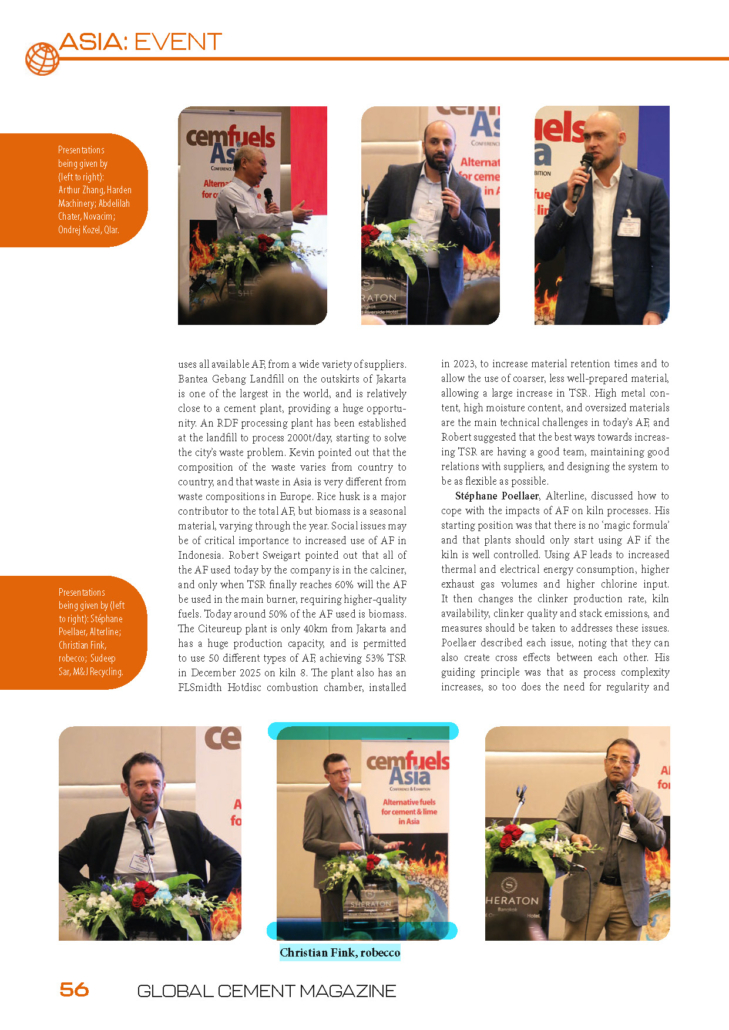
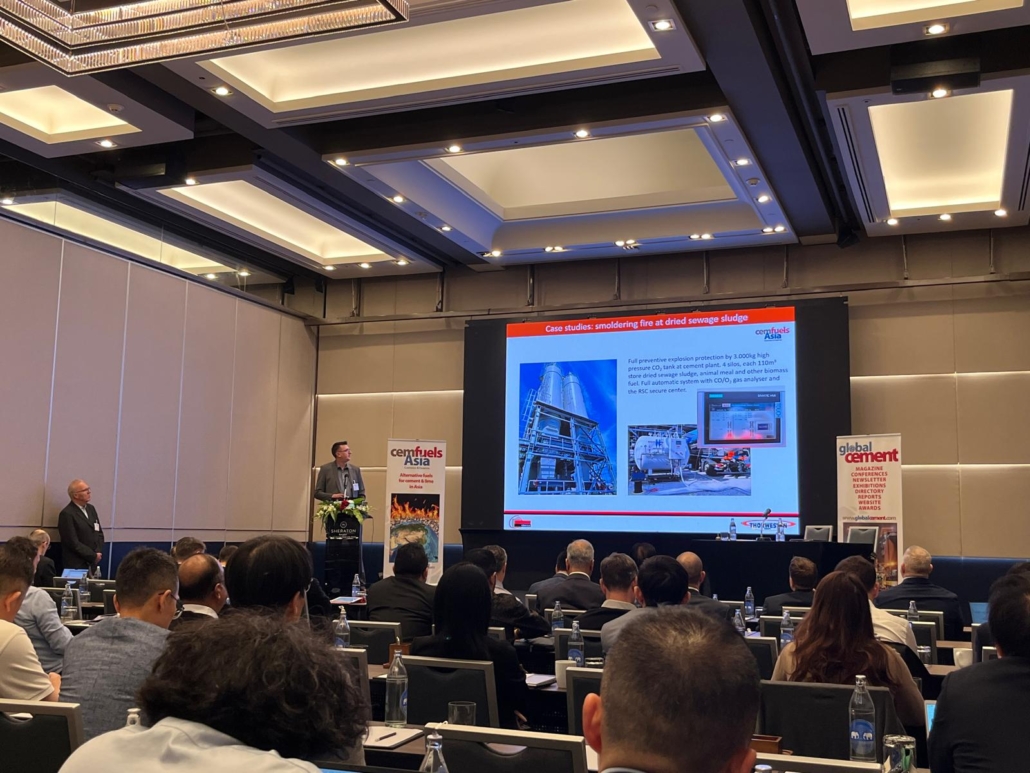
The first presenters on the second day of the con-ference were Christian Fink from robecco and Berthold Bussieweke of Thorwesten Vent, who spoke about safe handling and storage of AF and coal (coal still being a main fuel in Asia). Berthold suggested that silos should be vented by means of self-re-closing explosion venting devices, to avoid secondary explosions. Christian then suggested that inert gases can prevent the occurrence of the criti-cal parameters that lead to explosions or fires in AF and coal. Explosions cannot happen at an oxygen concentration of less than 8%, while smouldering or glowing fires are extinguished by reducing the oxy-gen concentration to less than 2-3%. It is important to have enough inert gas to be able to purge the at-mosphere in the vessel in question two or three times over, and within 30-60 minutes. Ideally, the inerting process should be triggered automatically with sen-sors, rather than relying on the actions of the central control room. Both presenters underlined the fact that sewage sludge, animal meal and other biomass fuels are potentially dangerous materials – and that care must be taken when handling and storing them.
Luc Rieffel of Walter Materials Handling (WMH), ATS Group, then spoke about his com-pany’s AF systems in real applications in Thailand. He suggested that the TSR in Asia will increase from 10% today to around 55% by 2050. WMH can pro-vide all of the equipment that is required for AF use, in both calciner and main burner, from material re-ception, material storage (including with automatic cranes), dosing extractors, weighbelt feeders and double-valve airlocks. Luc mentioned case studies in several plants in Thailand.
Jason Ottavi of Swiss company SID SA then spoke about his company’s AF equipment in use in Southeast Asia and in China, which he described as having ‘Swiss quality, but a Chinese price.’ The company supplies a wide variety of shredders, depending on the intended AF, as well as windsift-ers, screens, pumps, conveyors and mixers. The company specialises in the SMP system, which is an entirely-enclosed nitrogen-inerted shredding-mixing-pumping system, which is ideally designed for processing hazardous waste. SID can provide systems to produce RDF from MSW, and also tyre-derived fuel (TDF).
Arthur Zhang, Harden Machinery, described how his company focuses on manufacturing ma-chines for the pre-processing of RDF. It has supplied products to more than 100 RDF plants, to more than 100 cement plants, more than 80 thermal power plants and to more than 230 hazardous waste disposal projects. It has had a notable presence in China since it was founded in 2010, and it became a member of the China Alternative Fuel Standards Committee in 2021. Various case studies in China and South Korea were discussed.
Sunil Kumbhar, AltSF Process, started his talk by describing the pace of change in the AF sector in India since 2011. Manual processing with capacities of below 10t/day has moved to investment in pre-processing and capacities up to 60t/day, although challenges remain such as moisture, impurities, poorly processed MSW and a lingering reliance on manual labour. Further automation and a TSR of above 50% is expected by 2035. The company is building a system for Kuwait Cement with a 60t/hr feeding rate and this is expected to be commissioned in 2026. It is also supplying an AFR system for a new production line that JSW Cement is building with completion scheduled for May 2026.
Abdelilah Chater, NOVACIM, presented research results on the ef-fects of AF on clinker formation and the impact of chlorine from RDF on concrete durability. A study on intro-ducing P2O5 from sewage sludge on alite formation revealed that the type of apatite present in the raw mate-rial had an effect on the compressive strength of the resulting clinker. Chlorapatite produced a cement with strong hydraulic performance, driven by its high alite content. Meanwhile a study of concrete life using the Monte Carlo model for chloride penetration demonstrated that higher levels of RDF used to make the cement could poten-tially reduce the lifespan by up to 15 years.
Ondrej Kozel, Qlar, commented on the poten-tial for blended cements in Asia, given the region’s high proportion of global fly ash production. He described how Qlar, formerly Schenck Process, started its AF journey in the region in India in 2013 with a project that demonstrated the importance of specifying the quality of the available AF feedstock for the equipment being used. Notably, spirals were replaced with screws at the site. In other case stud-ies, Kozel noted that there are AFs in Asia that are not commonly available in Europe. In Vietnam, for example, shoes and clothing byproducts from manufacturing are being processed. The company was also pleased to announce that an AF installation at Shanya South Cement Group, China, in 2025 was supplied from Qlar’s new manufacturing plant in China with support from a unit in India.
Varun Boralkar, Blue Planet, introduced his company as the largest landfill mining company in India. Since 2015 it has processed 15Mt of MSW from legacy sites in about 40 projects. Government policy has been a major driver as it subsidises the initiative and makes the process profitable. The com-pany is obliged to provide traceability for the waste it processes. From such sites, 18-25% of the material can be converted into RDF, 4-6% is fine soil, 67-77% is coarse soil and stones and a final 1-2% fraction consists of iron and glass scrap that can be recycled. The company hopes to reach over 1Mt of RDF sup-plied in 2025-2026. Blue Planet has a particular relationship with Vicat and is also currently explor-ing supplying the paper mill sector. Finally, Boralkar noted that a key change for RDF usage in India oc-curred in 2015 when solid waste management rules changed to prioritise co-processing above landfill. Since then, RDF utilisation has risen.
Sudeep Sar of M&J Recycling spoke about his company’s shredders. The company’s machines use asynchronous shredding rolls, where the rolls rotate at different rates, and all are electrically powered. Decelerating rotors are used for electrical energy regeneration and to transfer power to the accelerat-ing rotor.
The final presentation at the conference was given by Jan Tuma of Beumer Czech Republic who gave details of a number of AF handling and convey-ing projects in Asia and the Middle East, and who gave details of his company’s various different equip-ment offerings for AF.
A wide-ranging audience discussion of AF trends in Asia then emphasised the point that the sector is undergoing rapid acceleration in Asia, albeit faster in some countries than in others.
Prizes and farewells
At the end of the conference the best presentation awards, based on delegate voting, were given out. In third place was Varun Boralkar of BluePlanet, for his paper on landfill mining in India, and in second place was Pavel Cech of ResourceCo for his presentation on AF trends in Asia. In first place were Robert Sweigart and Kevin Chandra from PT Indocement, for their interesting talk on alternative fuel trends in Indonesia.
On the day after the main conference, a number of delegates were hosted by Asia Cement for a fasci-nating visit to the company’s Pukrang cement plant, 135km north of Bangkok.
Delegates praised the conference for its slick organisation, excellent networking and the high pro-portion of cement producers. Exhibitors were very pleased with the level of new enquiries generated. The 2nd CemFuels Asia Conference will next take place in January 2027 in Kuala Lumpur, Malaysia.